Enhancing Performance Through Effective Corporate Governance
Written By: Hilman Badhi Adikara, GRC Team Leader – Robere & Associates (Indonesia)
Corporate governance serves as the fundamental bedrock for any company’s success. In the current era of globalization and escalating competition, companies that adeptly implement sound corporate governance practices possess a significantly greater likelihood of achieving sustainable growth. Corporate governance can be defined as the framework and management practices employed by a company to oversee and direct its operations. This encompasses the relationships among shareholders, the board of commissioners, the board of directors, and other relevant stakeholders.
To ensure effective implementation, companies can adhere to relevant regulations pertinent to their business processes or consult other reference frameworks on corporate governance.
Why is Corporate Governance Crucial for Companies?
Fundamentally, corporate governance represents the essential foundational rules that companies must possess to support effective and efficient business processes and to facilitate the achievement of corporate objectives. Unfortunately, several companies currently do not fully comprehend the paramount importance of robust corporate governance.
Key benefits of implementing sound corporate governance include:
- Enhancing long-term stakeholder value.
- Effective stewardship of resources.
- Increased corporate resilience and performance.
- Improved decision-making effectiveness.
- Better personnel composition and retention within the company.
- Fostering greater trust from parties with vested interests in the company.
- Increasing the value of intangible assets, such as reputation, public image, and public trust.
Regulatory References in Indonesia for Corporate Governance
Regarding the implementation of corporate governance, Indonesian regulators have established several regulations that dictate how companies should apply governance based on their specific business processes. Below are some regulatory references categorized by company type in Indonesia:
| Company Type | Corporate Governance Regulation |
|---|---|
| State-Owned Enterprises (BUMN) | Minister of SOE Regulation Number 2 of 2023 concerning Guidelines for Corporate Governance and Significant Corporate Activities of State-Owned Enterprises. |
| Insurance Companies | Financial Services Authority Regulation Number 73/POJK.05/2016 concerning Good Corporate Governance for Insurance Companies and Financial Services Authority Regulation of the Republic of Indonesia Number 7 of 2023 concerning Corporate Governance and Institutional Arrangements for Mutual Insurance Companies. |
| Commercial Banks | Financial Services Authority Regulation of the Republic of Indonesia Number 17 of 2023 concerning the Implementation of Corporate Governance for Commercial Banks. |
| Rural Banks | Implementation of Corporate Governance for Rural Banks. |
| Financing Companies | Financial Services Authority Regulation Number 30/POJK.05/2014 concerning Good Corporate Governance for Financing Companies. |
| Venture Capital Companies | Financial Services Authority Regulation Number 36/POJK.05/2015 concerning Good Corporate Governance for Venture Capital Companies. |
International Standards for Corporate Governance
The International Organization for Standardization (ISO) published an international standard for good corporate governance, ISO 37000, in 2021. ISO 37000 provides a comprehensive overview of corporate governance, along with its principles and the outcomes derived from its implementation. Here’s an overview of ISO 37000:2021:
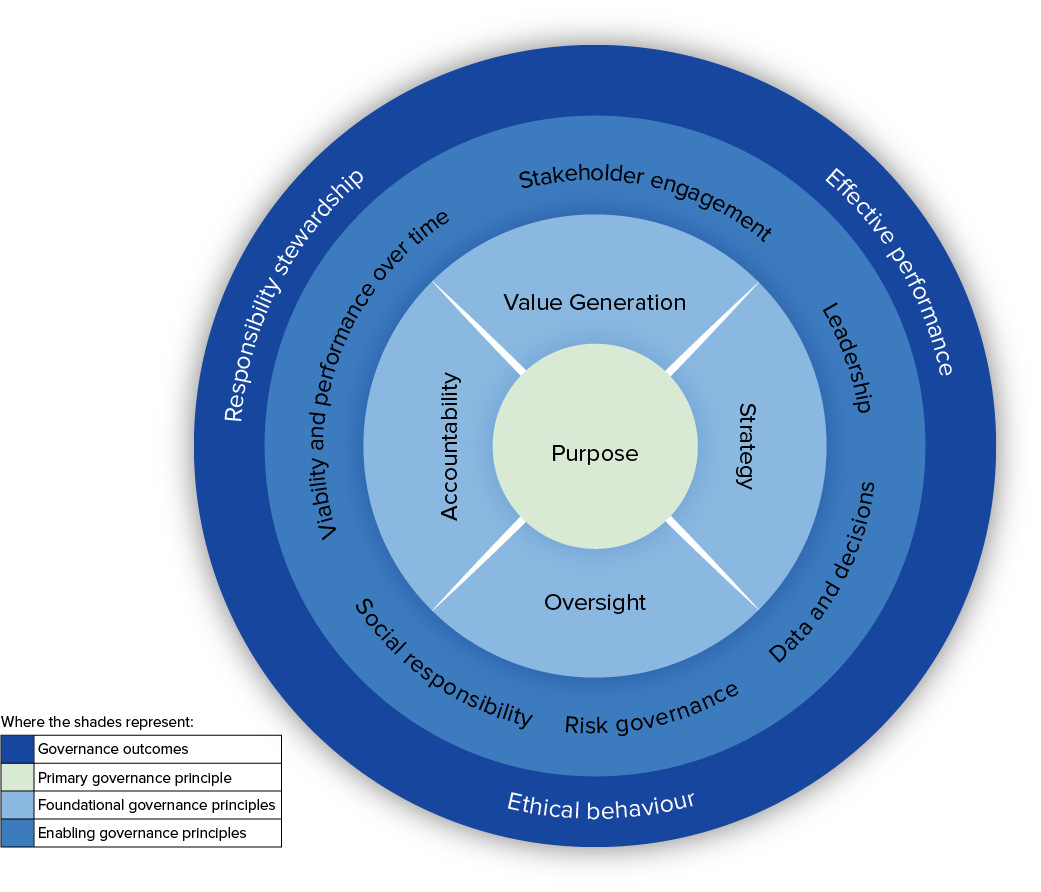
Integrating Purpose and Principles for Corporate Governance According to ISO 37000:2021
ISO 37000:2021 emphasizes the importance of companies having a clear Purpose as a primary principle. To support the achievement of this purpose, companies must establish their Value generation, strategy, oversight, and accountability within their business processes. These elements serve as foundational principles for implementing effective corporate governance. The application of primary and foundational principles requires support from enabling principles, which include leadership, data-driven decision-making, risk governance, social responsibility, stakeholder engagement, and corporate performance and sustainability.
Through the application of these primary, foundational, and enabling principles, companies can achieve outcomes consisting of:
- Effective performance: The company operates in accordance with its objectives and applicable requirements, enhances stakeholder value, and aligns with the policies and expectations of relevant stakeholders.
- Responsible stewardship: The company utilizes resources responsibly, balances positive and negative impacts arising from its operations, considers the global context influencing its business, ensures its contribution to sustainable development, and fosters trust and confidence from the communities in which it operates.
- Ethical behavior: The company conducts itself in accordance with accepted principles and prevailing norms, such as an ethical culture, accountability, fairness in treatment and engagement with stakeholders, integrity and transparency in fulfilling its obligations, and competence and honesty in decision-making.